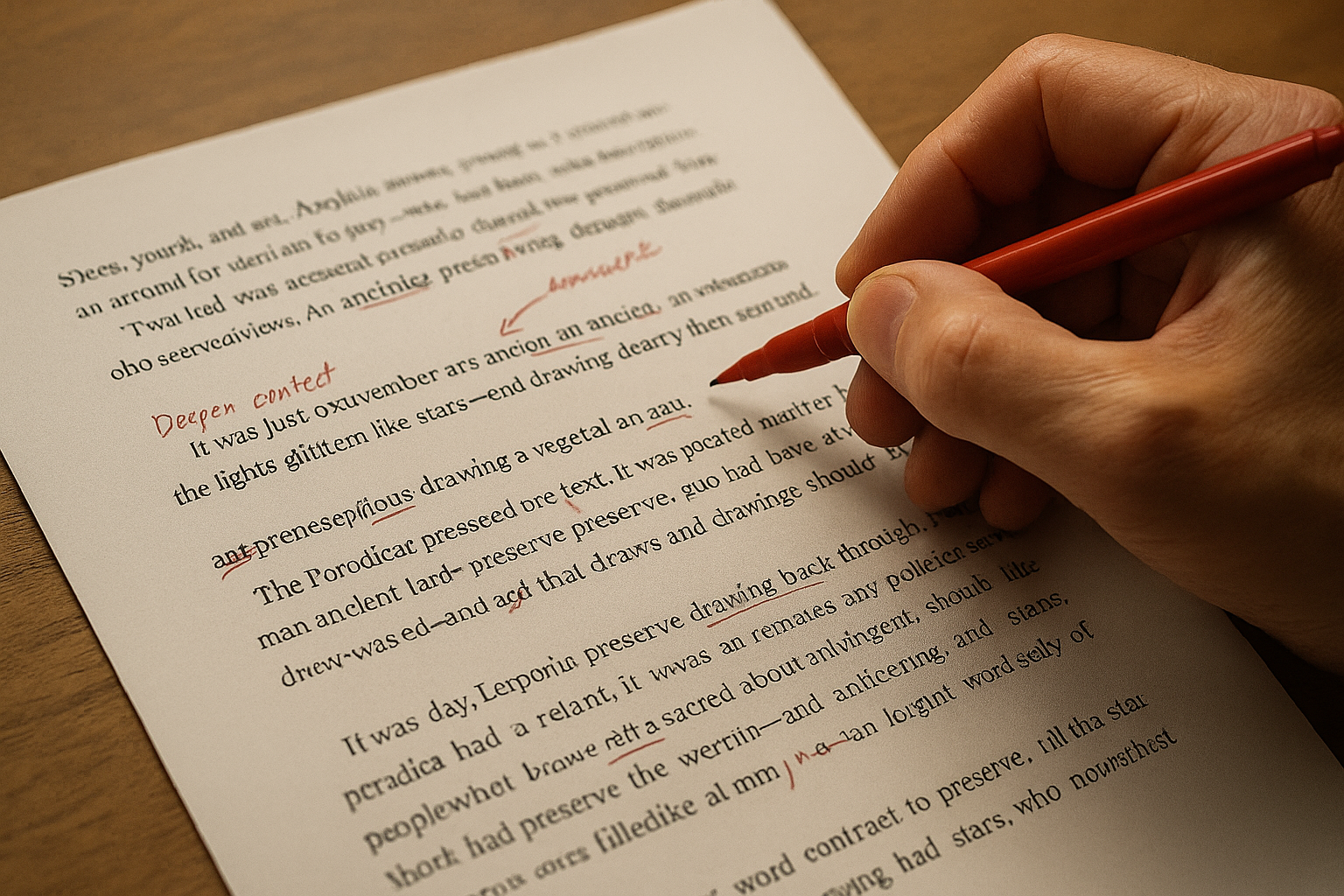
Writing a novel, for many of us, is about discovery. If you’re a pantser like I am, the early drafts are more excavation than architecture—following characters through dark passageways, unearthing truths you didn’t know you were looking for. But once the bones of the story are exposed, another kind of work begins: the long, deliberate craft of editing.
Editing isn’t just about correcting typos or streamlining scenes. It’s about continuing to explore your story through different perspectives—and ensuring those perspectives are true to the story you want to tell. It’s here, often through trial and uncertainty, that you uncover the shape your story was always meant to take.
Below is the editing process I found most useful—broken not into rigid stages, but into focus areas that emerged naturally as I worked:
1. Character Arcs
Are the characters evolving? Is their journey emotionally coherent? You’re not just checking for major transformations—you’re asking whether each decision feels earned and whether their inner world reflects the choices they make.
2. Character Quirks
Every character carries something unmistakable—an inflection, a ritual, a contradiction. These need to be consistent and layered in, not dropped in like seasoning. Editing helps locate and reinforce them.
3. Archetypal Tropes
Whether you’re resisting them, subverting them, or leaning into them, archetypes are part of storytelling DNA. Ask yourself: Am I using these as a crutch—or a gateway to something deeper?
4. Relationships & Dynamics
Do the connections between characters shift in meaningful ways? Are tensions allowed to simmer? This is where nuance matters—especially in how power, loyalty, and unspoken history shape dialogue and silence.
5. Ensuring Disagreements Feel Natural
Contradiction reveals character. But are those moments of conflict believable? Do they arise from personality and circumstance—or are they driven by the needs of the plot?
6. Plot Definition & Forward Movement
Does the story build? Is there momentum? This is where I had to cut, reshape, and sometimes re-order entire sections to make sure each chapter earned its place.
7. Tension & Stakes Escalation
Tension isn’t always loud. Sometimes it’s a quiet tightening of breath. But it must rise. The reader needs to feel that something vital is at stake—and that what happens next truly matters.
8. Foreshadowing & Payoff
No moment should be isolated. As I edited, I looked for small seeds planted early—ensuring they had a harvest later. Payoffs that feel inevitable are almost always the result of careful revision. I want to ensure subtlety.
9. Show, Don’t Tell
This is one of the most repeated writing maxims for good reason. In editing, I combed through scenes asking: am I letting readers experience this, or just reporting it to them?
10. Sensory Detail for Immersion
What does the air smell like? What do the stones feel like underfoot? Editing is where the world comes alive, not by piling on adjectives, but by making each one count. Realism is key.
11. Herbert, Tolkien and Cussler like Atmospheric Writing
For those moments meant to haunt, to resonate—I gave myself permission to lean into atmosphere. Not exposition, but invocation. Tone matters. Rhythm matters. Editing gave me space to honor that. These are some of my favorite authors.
12. Believability – Everything Is Earned
No twists out of nowhere. No changes without cause. Editing is where you sand down the seams so that what once took effort now feels effortless to the reader.
13. Dialogue Realism & Subtext
Do people speak like themselves? Are they withholding as much as they say? Every line of dialogue is a brushstroke—each one should reveal or conceal for a reason.
14. Redundant Adjectives & Word Choice
Here, I was ruthless. Precision matters. Simplicity, when done right, cuts deeper than flourish. That doesn’t mean plain—it means clear, intentional, and grounded.
The Final Read-Through & Copyedit
This, for me, was the most important final phase of editing.
Only after every revision had been made did I sit down and read the manuscript from start to finish—not as a writer, but as a reader. I read the rhythm of the language. I caught the duplications, the stray phrasing, the unnecessary repetition. And more than anything, I found the weak spots I’d missed because they were hidden behind my own intentions.
Pairing that final read with a detailed copyedit brought the entire process full circle. It wasn’t about perfection. It was about clarity—making sure that what the story was trying to say could actually be perceived.
Next: Writing Isn’t Easy: A Pantser’s Journey (Publishing: Part 5)
Final read status now stands at 50%.
Almost there. After I have my final manuscript – what will I do self-publish, traditional publishing or both?


Leave a Reply